

Recently my family and I spent a few days in Lyme Regis. Walk along the beach there and the cliffs show you time. Band after band of rock is stacked up, each one a stretch of history laid down on the one before. The fossils sit in those layers: ammonites everywhere, and if you are very lucky, something bigger. Two hundred years ago Mary Anning made her living on that beach, finding fossils and selling them to visitors. In her day fossils were seen as curiosities, and many of her finds now sit in the Natural History Museum in London (Lyme Regis Museum, n.d.).

On one of our procedure writing courses, someone described a procedure in a way that took me straight back to that beach. They said it was like a historical document. If you knew the process, you could read it and make sense of it: this caution came in after we had that deviation, this check after that audit, these icons came into use when a particular author took over. The evolution of the task, and every problem it ever had, was there on the page.
Each revision of a procedure is like a layer in that cliff: a set of additions made at one time, usually in response to one event, such as a deviation, an audit or a change. The individual additions within each layer are the fossils, and each one has a story.
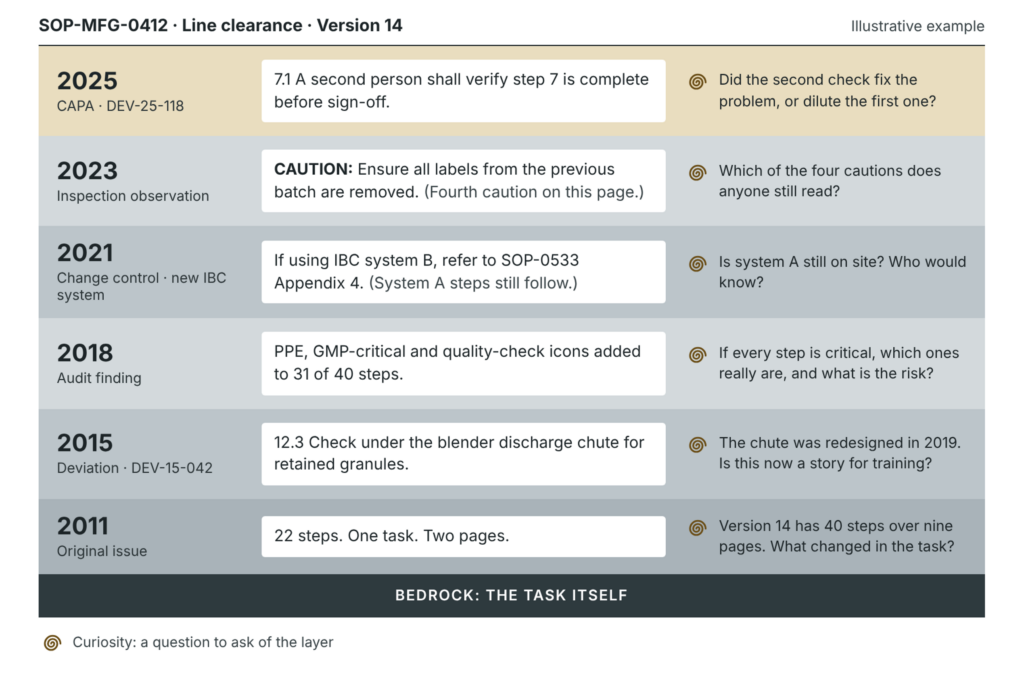
That is a lovely idea, and also a real problem. This blog looks at why procedures only ever seem to grow, why that matters, and how to shrink them without losing what they have learned. It follows on from our earlier blog, Procedure Burden: Reducing Cognitive Load, which looked at the load a procedure puts on the person using it. Bloat is one of the main ways that burden builds up.
How procedures grow
Nobody sets out to write a bloated procedure. Each addition is reasonable when it is made. A deviation is investigated and a step is added. An auditor asks how a risk is managed and a caution goes in. New equipment arrives and a branch is written for it, while the old route stays just in case. A new author brings a new set of icons. None of these is wrong on its own.
The trouble is the imbalance. Adding is cheap, quick and easy to defend. Removing is slow, needs a reason, and exposes whoever does it. Nobody gets thanked for deleting a step, and everybody remembers the person who removed the one that mattered.
Pharma has its own version of this. A deviation leads into the CAPA system, which needs a corrective and preventive action, and regulators expect that action to be effective. Updating the procedure is an easy way to show action. It is tangible and verifiable, within the site’s control, quick to do, and it leaves a clear document trail. Yet the effectiveness check on a procedure update often confirms that the update was made, not that it worked. So the procedure becomes the default place for lessons to land, whether or not it is the right place.
Anyone who has used software will recognise the pattern. Feature bloat happens when every feature was requested by someone for a good reason, most users only touch a fraction of them, and nobody is rewarded for taking any away. The product gets more capable on paper and harder to use in practice. Procedures go the same way.
The loop
Follow this through and you get a loop. A deviation happens. The CAPA needs a tangible fix, so something is added to the procedure. The procedure gets longer and harder to use, so people use it less at the point of work and rely more on memory and on each other. Work-as-done drifts away from work-as-documented (Shorrock, 2016), and another deviation happens.
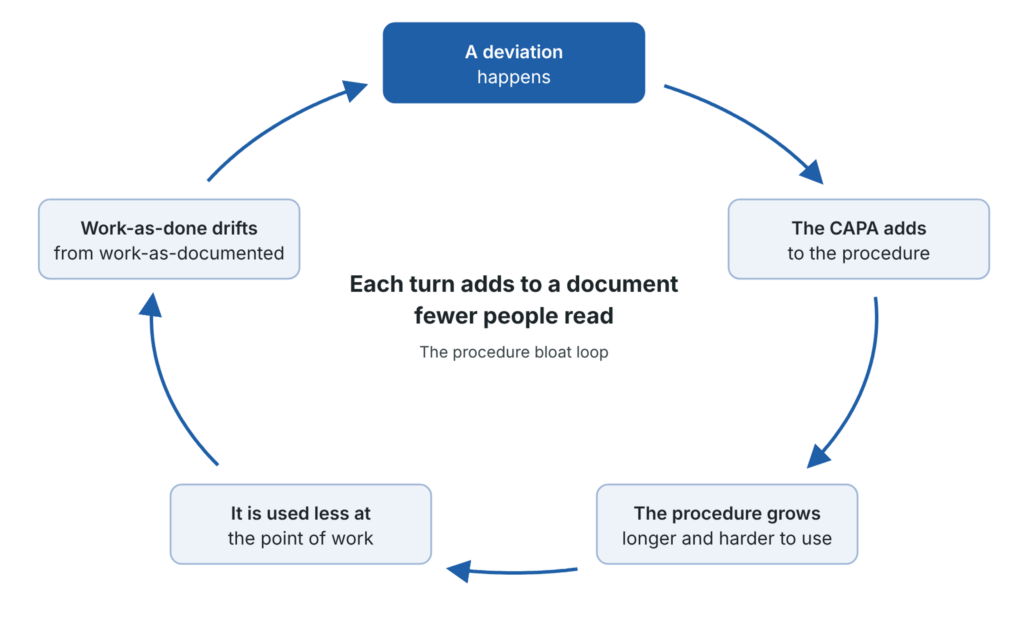
The more lessons we add to the procedure, the less likely anyone is to meet them. We end up adding to a document that fewer and fewer people read.
In pharma manufacturing the loop may turn faster. This is an informal observation from our work rather than a measured finding. Deviations are frequent, and those that are investigated often carry a perceived need to close out within around 30 days, with tangible evidence of a change. A procedure update is the quickest evidence to hand. Minor deviations are often handled differently: rather than being investigated one by one, they are tracked and trended to spot recurrence, as GMP expects. Trending is good at spotting repeated symptoms, but it rarely looks for the shared causes or system connections behind them. So when a trend does trigger action, the fix tends to address the symptom, and the procedure gains another layer.
The case for layers
This is not an argument against change. Procedures should evolve. Work changes, equipment changes, and we learn more about where tasks go wrong and what we need in place to support right first-time activity. A procedure that never changed would be a worry.
The biggest fossil we have found
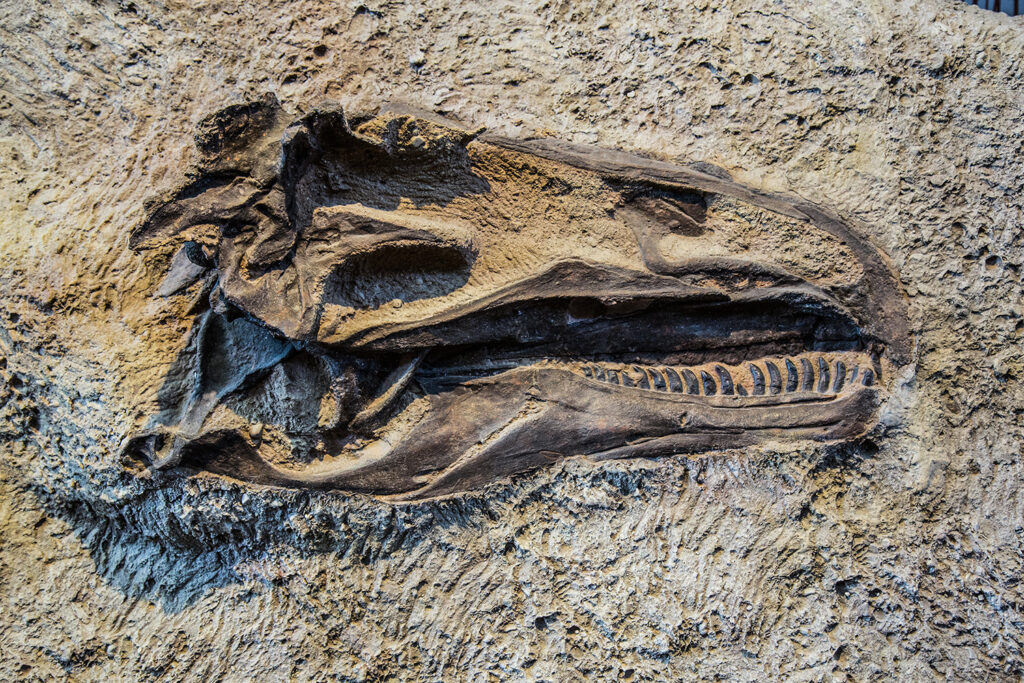
The opposite of bloat is a procedure that stops changing altogether. The largest one we have come across had not been updated for two decades. It came to light after a near miss, when the investigation pulled it out of the archive and found that operators were not following it. Our job was to review the procedure and bring work-as-imagined and work-as-done back together. On closer inspection the gap was huge. The plant had changed, the process had changed, and the procedure described a job that no longer existed.
Bloat and fossilisation look like opposites, but they share a root: in both, the procedure has stopped keeping step with the work.
The layers also hold something valuable. They are a form of organisational memory. To an experienced operator or a long-serving QA lead, a single caution can carry a whole story: the batch that was lost, the near miss for safety, the inspection. People on the course clearly valued that.
The catch is who can understand it. The old hands can, because they were there. A new starter sees only clutter: cautions with no reasons, checks with no context, steps that make no sense for the equipment in front of them. That new starter is exactly the person the procedure most needs to help. The history is valuable. It is just in the wrong document, for the wrong reader.
One document, four jobs
Part of the problem is that we ask a procedure to do too many jobs at once. On our courses we make the point that a procedure cannot be optimised for everything. To be explicit about it, a procedure is usually asked to do four jobs:
| Job | Who it serves | What good looks like |
| Do (in-hand use) | The competent person doing the task | Short, in sequence, easy to scan, critical steps standing out, room to record |
| Learn (training) | The person learning the task | The why, what good looks like, what has gone wrong before and how to troubleshoot effectively |
| Look up(reference) | Anyone checking one thing | Complete and quick to find: limits, settings, abnormal conditions |
| Prove (quality and safety management) | QA, auditors, inspectors and the organisation itself | Complete, traceable and version-controlled: the standard to check drift and abnormalities against |
These pull against each other. Do wants brevity. Learn wants explanation. Look up wants completeness. Prove wants traceability and compliance. Only one of the four happens with the task in hand, yet the other three tend to crowd in on top of it.
Three jobs, or five?
The jobs flex. If three suits you better, group Learn and Look up together as Know, since both are about knowledge held away from the step. We keep them apart because reference material bloats in its own way, through specification tables, appendices and cross-references, the same features behind the page-break problems we described in Procedure Burden.
You can also go the other way and add a fifth job: Record. In pharma the instructions and the batch record are often the same document, or closely tied, so the thing the operator follows is also the evidence of what was done for that batch. Record happens at the point of use, like Do, but it serves Prove. It pulls in its own direction too: more fields, more signatures, more verification boxes. Many CAPAs that “add a check” really add a signature box, so the record bloats alongside the instructions. Treating Record as a job of its own helps you ask whether each box is needed to do the work, or only to show it was done.
What we can learn from nuclear use levels
Readers from nuclear will recognise part of this. Many nuclear sites classify procedures by use level, and IAEA good practice describes three categories: continuous use, reference use and information use. Site management decides which activities need detailed procedures and verbatim compliance and which need lighter control, and each category says where the procedure is during the task, how it is used and what record of completion is needed (IAEA, 1998).
- Continuous use: the procedure is in hand and followed step by step, often signed off as you go. It is used for activities where the consequences call for close control.
- Reference use: the procedure is at the work location and checked at intervals to confirm the work is being done correctly.
- Information use: the procedure is available for guidance, and the task can be done from knowledge and training.
The parallels. Use levels accept that not every procedure needs to be in the hand to the same degree, and they link that decision to risk. Continuous use is close to Do. Information use is close to Learn and Look up. The record of completion is a version of Record.
Working together. Use levels help decide how a procedure should be used, based on the risk of the task. The four jobs offer a complementary lens on what goes into it. Asking which job each line is doing helps keep the in-hand document focused on what the user needs at the point of work, which matters most where every step is read and followed in order.
Version control
Version control has its own part to play. It is the Prove job over time. Under GMP every change is recorded, so the history of each layer already exists outside the steps. In practice, change records often say what changed but not why (“updated per CAPA”), so the reasons end up being carried in the procedure instead. Richer change records quietly make everything that follows easier.
Matching the fix to the failure
Rasmussen’s skills, rules and knowledge model (Rasmussen, 1983), and James Reason’s work that built on it (Reason, 1990), gives a useful test for where a lesson belongs.
Slips and lapses happen in skill-based performance, when a familiar task runs on autopilot. The person knows what to do, but their attention is elsewhere at the wrong moment. The fix belongs in the in-hand document: a hold point, a check, or a cue placed exactly where attention needs to switch from autopilot to deliberate thought.
Mistakes are different. At the rule-based level, someone applies the wrong rule, or the right rule in the wrong situation. At the knowledge-based level, they are working something out from first principles and their understanding is incomplete. Another line in the procedure rarely fixes understanding. Training does, and so does reference material that supports diagnosis.
There is a caveat. A check only pulls someone out of autopilot if it is rare enough to notice. Put one on every step and checking becomes its own routine, done on autopilot. In-hand checks are a resource to spend carefully, on the steps that matter most.
Spotting bloat
Bloat tends to arrive at predictable moments:
- CAPAs following deviations
- audit findings and inspection observations
- change controls for new equipment or materials
- merging procedures across lines or sites
- periodic reviews that only ever add
- a change of author or document owner
And it leaves signs on the page:
- cautions and notes stacked up, sometimes several to a page
- icons on nearly every step, so none of them stand out
- verification steps layered on verification steps
- branches for equipment or materials no longer on site
- duplicated instructions that have drifted apart
- steps nobody can explain, but nobody dares remove
- multiple cross-references to many different documents
- a document that has doubled in length while the task has barely changed
Give each lesson a home
Resisting bloat starts at the moment of the change. Before anything is added, ask which job it is for. If the user does not need it at the point of use to do the step correctly, it belongs somewhere else.
Learn: training that proves competence, not just reading. In GMP the SOP is often the training document. People sign to say they have read and understood it, so the procedure carries the whole load. That signature shows someone has read the document, not that they can do the task. A separate training document is where the why belongs, along with the history of past errors told as stories: what happened, why it mattered, and what to look out for. That is a far better way to pass on organisational memory than an unexplained caution.
Training Within Industry (TWI) job breakdowns are a good model, and many pharma sites already know them. They separate the important steps, the key points and the reasons for the key points (Dinero, 2005), which is the same split we are making between Do and Learn. Sign-off then rests on demonstrated competence rather than a signature. Read-and-understood still has its place, for example for minor changes. For critical tasks, demonstrated competence is the step up. Our blog Beyond the Training Matrix looks at competence in more depth.
Look up: reference material, kept and controlled separately, and pointed to only where it is needed.
Prove: the version history and change records, with the rationale written down.
Design it out. Some lessons should not be written anywhere. If an error keeps recurring, the strongest fix is often higher up the hierarchy of control: an engineering change, a better interface, an interlock. Adding to a procedure is an administrative control. The hierarchy of control ranks ways of managing risk from most to least effective: eliminate the hazard, substitute something safer, engineer it out, then administrative controls such as procedures, training, signs and checks, and finally personal protective equipment. Administrative controls sit near the bottom because they rely on people noticing and acting on them every time. We made a similar point about investigations in What’s on Your DMAIC Tool Belt?
A training document is a controlled document too, and it can bloat in exactly the same way. It needs an owner and the same discipline. It also needs to be used. The stories of past errors make good material for onboarding, pre-job briefs, shift handovers and coaching on the floor. Brought into everyday operational conversations, the history stays alive rather than sitting in a file.
Shrinking safely
Removing content from a GMP procedure is a change like any other, and should be treated as one. The aim is not to tidy up. It is to put every line back in the right place, through a documented, risk-based review in line with ICH Q9(R1) (ICH, 2023). Four questions help with every layer:
- Why is it here? Trace it to its origin: deviation, audit, inspection or change. The version history is your map.
- Is the reason still live? Equipment, people, hazards and the process may all have moved on.
- Is it needed in the hand? Does the user need it at the point of use to do this step correctly?
- If not, which job is it doing? Move it to training, reference or the record, or design it out.
Some practical points:
- Review the procedure, training material and standard work for a process together, not one document in isolation. Seeing the whole set makes it much easier to find the right home for each piece of content.
- Log each removal with its origin and rationale, so the answer to “where did that go?” is on file.
- For heavily layered procedures, rebuild from the task rather than patch. A hierarchical task analysis gives you the structure of the work, and you can then decide what each step really needs.
- Test the result with the people who use it.
- Close the loop with an effectiveness check, so the slimmer procedure is shown to work rather than assumed to.
- Expect some administrative controls to earn their place. A well-placed independent check on a high-consequence step is worth keeping. The review decides which ones stay.
Go fossil hunting
Walk along the beach at Lyme Regis at low tide and you will see people bent over the fallen rock, turning stones and looking for fossils. Nobody is trying to knock down the cliff. They are looking closely at what has come to light, asking what it is, and deciding what is worth keeping.
That is the attitude we would suggest for procedures. Each addition is a find. Pick it up and ask what it is, where it came from and whether its reason is still live. Then decide where it belongs: in the hand, in training, in reference material, in the record, or designed out altogether. A good reviewer is a fossil hunter, not a demolition crew.
To start, pick one procedure, ideally the one everyone agrees has grown too long. Walk through it with the four questions: Why is it here? Is the reason still live? Is it needed in the hand? If not, which job is it doing? Aim to find three things:
- one thing to move to where it belongs, whether that is training, reference or the record
- one thing to design out
- one thing to remove, with its origin and rationale logged
Then test the slimmer version with the people who use it, and check that it works.
Mary Anning’s fossils were called curiosities for a reason: they made people ask questions. The best procedure reviews start the same way.
If you would like help reviewing or rebuilding your procedures, or running this exercise with your team, get in touch. For the cognitive load side of the story, read Procedure Burden.
Acknowledgements: thanks to Julie Avery for her review, and for sharpening the points on CAPA, training and the wider document set.
Author’s note: this blog was drafted with the help of AI (Claude, Anthropic). The ideas, examples and editorial responsibility are the author’s own.
References
Dinero, D. A. (2005). Training Within Industry: The foundation of lean. Productivity Press.
ICH. (2023). Q9(R1): Quality risk management. International Council for Harmonisation of Technical Requirements for Pharmaceuticals for Human Use.
International Atomic Energy Agency. (1998). Good practices with respect to the development and use of nuclear power plant procedures (IAEA-TECDOC-1058). IAEA.
Lyme Regis Museum. (n.d.). The Mary Anning experts. https://www.lymeregismuseum.co.uk/about-us/the-mary-anning-experts/
Rasmussen, J. (1983). Skills, rules, and knowledge; signals, signs, and symbols, and other distinctions in human performance models. IEEE Transactions on Systems, Man, and Cybernetics, SMC-13(3), 257-266.
Reason, J. (1990). Human error. Cambridge University Press.
Shorrock, S. (2016). The varieties of human work. Humanistic Systems. https://humanisticsystems.com/2016/12/05/the-varieties-of-human-work/