
Beyond “root cause: human error”. Five principles for investigators.

Root cause: human error.
Corrective action: retrain operator.
If you have worked in incident investigation for any length of time, you have read that pair of lines. Some of us have written them.
It gets the report closed. It satisfies the template. And a few months later something uncomfortably close to it happens again…
The Second Story Has Layers: How Deep Does Your Investigation Go?
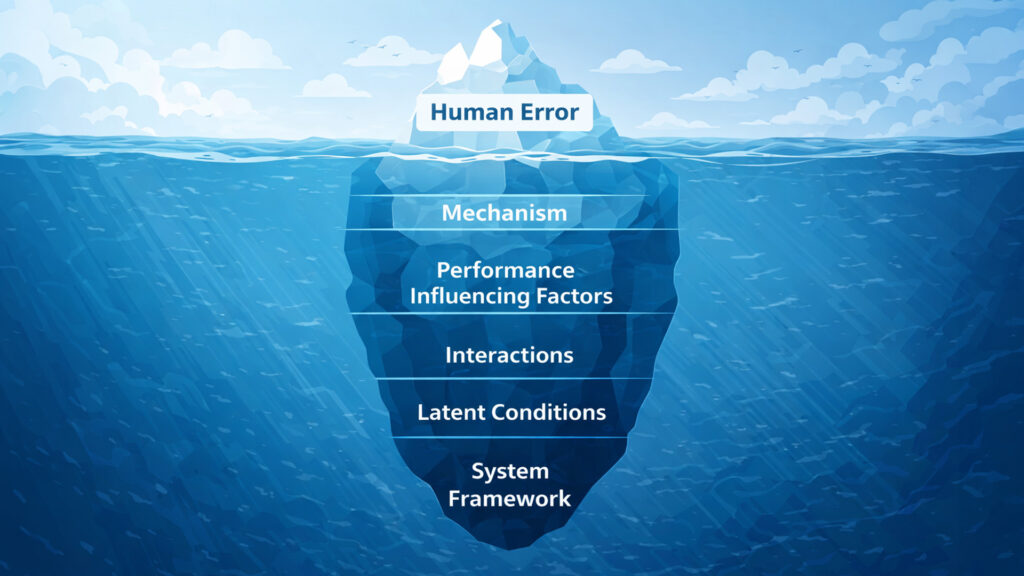
If your incident investigation ends with “human error” as the root cause, you haven’t finished the investigation. You’ve just stopped asking questions.
SCTA in Reverse (Part 3): Reflections, Challenges, and the Emerging TABIE Toolbox

We can finally close the gap between proactive SCTA and reactive investigation, using the same analytical framework to both prevent disasters and understand them when prevention fails.
SCTA in Reverse (Part 2): Dissecting the Herald of Free Enterprise Disaster with TABIE Tools

This is part 2 of our “SCTA in Reverse” series, diving deep into the Herald of Free Enterprise disaster through the lens of TABIE (Task Analysis Based Incident Evaluation).
SCTA in Reverse (Part 1): Learning from the Herald of Free Enterprise Disaster

On March 6, 1987, the Herald of Free Enterprise capsized in just 4 minutes after leaving Zeebrugge, killing 193 people. The immediate cause was clear – sailing with bow doors open. But the real lessons lie deeper.
Kegworth Revisited: A Case for Systemic Thinking

On 8 January 1989, British Midland Flight 92 crashed just short of East Midlands Airport, killing 47 people. But the Kegworth disaster wasn’t just about a mistaken decision, it was the result of multiple system failures.
The 2005 Stockwell Shooting: A lethal stew whose ingredients had been long in the cooking

Using the 2005 Stockwell shooting as a case study, this blog demonstrates how major incidents rarely result from single failures, but rather from the alignment of multiple systemic weaknesses across five stages.
Using SEIPS to Understand and Improve Patient Safety
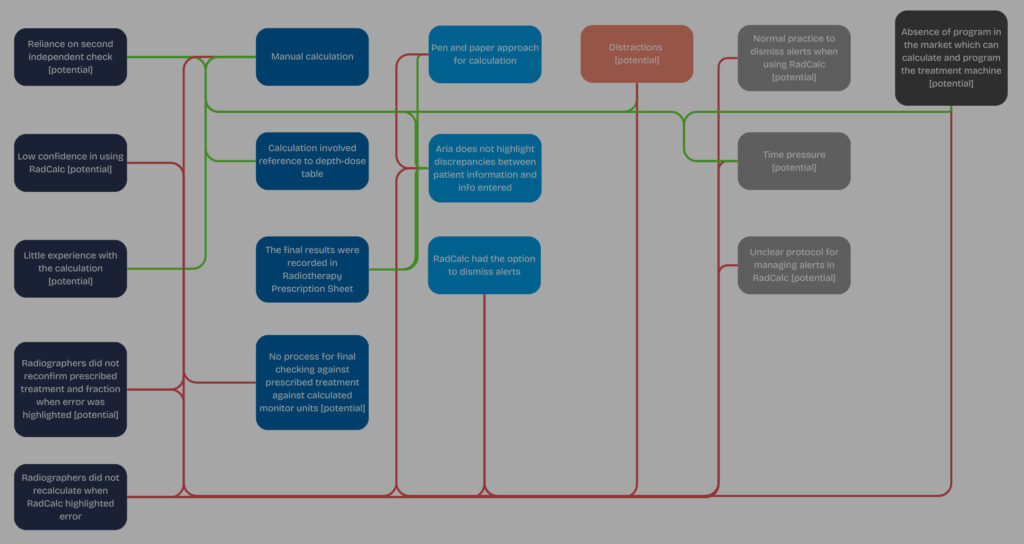
Lydea’s latest blog explores how the Systems Engineering Initiative for Patient Safety (SEIPS) framework help move human error beyond individual actions to systemic factors that contribute to such incidents.
The blog identifies key vulnerabilities and explores potential opportunities for improvement to enhance patient safety.
Beyond the Basic HSE PIF list: Reflections on types of Performance Influencing Factors
We often rely on standard HSE checklists for identifying Performance Influencing Factors, but there’s so much more to consider.
Revisiting the Swimlane Method: A Healthcare Case Study to Improve Patient Safety

Lydea’s latest blog explores how Swimlane could be applied in the healthcare industry. By mapping out the sequence of events, the tool helped uncover opportunities to improve processes and enhance safety.